
CPC Report; An unabashedly liberal perspective

| Friends and Fellow-Citizens: CALLED upon to undertake the duties of the first executive office of our country, I avail myself of the presence of that portion of my fellow-citizens which is here assembled to express my grateful thanks for the favor with which they have been pleased to look toward me, to declare a sincere consciousness that the task is above my talents, and that I approach it with those anxious and awful presentiments which the greatness of the charge and the weakness of my powers so justly inspire. A rising nation, spread over a wide and fruitful land, traversing all the seas with the rich productions of their industry, engaged in commerce with nations who feel power and forget right, advancing rapidly to destinies beyond the reach of mortal eye—when I contemplate these transcendent objects, and see the honor, the happiness, and the hopes of this beloved country committed to the issue, and the auspices of this day, I shrink from the contemplation, and humble myself before the magnitude of the undertaking. Utterly, indeed, should I despair did not the presence of many whom I here see remind me that in the other high authorities provided by our Constitution I shall find resources of wisdom, of virtue, and of zeal on which to rely under all difficulties. To you, then, gentlemen, who are charged with the sovereign functions of legislation, and to those associated with you, I look with encouragement for that guidance and support which may enable us to steer with safety the vessel in which we are all embarked amidst the conflicting elements of a troubled world. |
|
| During the contest of opinion through which we have passed the animation of discussions and of exertions has sometimes worn an aspect which might impose on strangers unused to think freely and to speak and to write what they think; but this being now decided by the voice of the nation, announced according to the rules of the Constitution, all will, of course, arrange themselves under the will of the law, and unite in common efforts for the common good. All, too, will bear in mind this sacred principle, that though the will of the majority is in all cases to prevail, that will to be rightful must be reasonable; that the minority possess their equal rights, which equal law must protect, and to violate would be oppression. Let us, then, fellow-citizens, unite with one heart and one mind. Let us restore to social intercourse that harmony and affection without which liberty and even life itself are but dreary things. And let us reflect that, having banished from our land that religious intolerance under which mankind so long bled and suffered, we have yet gained little if we countenance a political intolerance as despotic, as wicked, and capable of as bitter and bloody persecutions. During the throes and convulsions of the ancient world, during the agonizing spasms of infuriated man, seeking through blood and slaughter his long-lost liberty, it was not wonderful that the agitation of the billows should reach even this distant and peaceful shore; that this should be more felt and feared by some and less by others, and should divide opinions as to measures of safety. But every difference of opinion is not a difference of principle. We have called by different names brethren of the same principle. We are all Republicans, we are all Federalists. If there be any among us who would wish to dissolve this Union or to change its republican form, let them stand undisturbed as monuments of the safety with which error of opinion may be tolerated where reason is left free to combat it. I know, indeed, that some honest men fear that a republican government can not be strong, that this Government is not strong enough; but would the honest patriot, in the full tide of successful experiment, abandon a government which has so far kept us free and firm on the theoretic and visionary fear that this Government, the world's best hope, may by possibility want energy to preserve itself? I trust not. I believe this, on the contrary, the strongest Government on earth. I believe it the only one where every man, at the call of the law, would fly to the standard of the law, and would meet invasions of the public order as his own personal concern. Sometimes it is said that man can not be trusted with the government of himself. Can he, then, be trusted with the government of others? Or have we found angels in the forms of kings to govern him? Let history answer this question. | |
| Let us, then, with courage and confidence pursue our own Federal and Republican principles, our attachment to union and representative government. Kindly separated by nature and a wide ocean from the exterminating havoc of one quarter of the globe; too high-minded to endure the degradations of the others; possessing a chosen country, with room enough for our descendants to the thousandth and thousandth generation; entertaining a due sense of our equal right to the use of our own faculties, to the acquisitions of our own industry, to honor and confidence from our fellow-citizens, resulting not from birth, but from our actions and their sense of them; enlightened by a benign religion, professed, indeed, and practiced in various forms, yet all of them inculcating honesty, truth, temperance, gratitude, and the love of man; acknowledging and adoring an overruling Providence, which by all its dispensations proves that it delights in the happiness of man here and his greater happiness hereafter—with all these blessings, what more is necessary to make us a happy and a prosperous people? Still one thing more, fellow-citizens—a wise and frugal Government, which shall restrain men from injuring one another, shall leave them otherwise free to regulate their own pursuits of industry and improvement, and shall not take from the mouth of labor the bread it has earned. This is the sum of good government, and this is necessary to close the circle of our felicities. | 3 |
| About to enter, fellow-citizens, on the exercise of duties which comprehend everything dear and valuable to you, it is proper you should understand what I deem the essential principles of our Government, and consequently those which ought to shape its Administration. I will compress them within the narrowest compass they will bear, stating the general principle, but not all its limitations. Equal and exact justice to all men, of whatever state or persuasion, religious or political; peace, commerce, and honest friendship with all nations, entangling alliances with none; the support of the State governments in all their rights, as the most competent administrations for our domestic concerns and the surest bulwarks against anti-republican tendencies; the preservation of the General Government in its whole constitutional vigor, as the sheet anchor of our peace at home and safety abroad; a jealous care of the right of election by the people—a mild and safe corrective of abuses which are lopped by the sword of revolution where peaceable remedies are unprovided; absolute acquiescence in the decisions of the majority, the vital principle of republics, from which is no appeal but to force, the vital principle and immediate parent of despotism; a well disciplined militia, our best reliance in peace and for the first moments of war, till regulars may relieve them; the supremacy of the civil over the military authority; economy in the public expense, that labor may be lightly burthened; the honest payment of our debts and sacred preservation of the public faith; encouragement of agriculture, and of commerce as its handmaid; the diffusion of information and arraignment of all abuses at the bar of the public reason; freedom of religion; freedom of the press, and freedom of person under the protection of the habeas corpus, and trial by juries impartially selected. These principles form the bright constellation which has gone before us and guided our steps through an age of revolution and reformation. The wisdom of our sages and blood of our heroes have been devoted to their attainment. They should be the creed of our political faith, the text of civic instruction, the touchstone by which to try the services of those we trust; and should we wander from them in moments of error or of alarm, let us hasten to retrace our steps and to regain the road which alone leads to peace, liberty, and safety. | |
| I repair, then, fellow-citizens, to the post you have assigned me. With experience enough in subordinate offices to have seen the difficulties of this the greatest of all, I have learnt to expect that it will rarely fall to the lot of imperfect man to retire from this station with the reputation and the favor which bring him into it. Without pretensions to that high confidence you reposed in our first and greatest revolutionary character, whose preeminent services had entitled him to the first place in his country's love and destined for him the fairest page in the volume of faithful history, I ask so much confidence only as may give firmness and effect to the legal administration of your affairs. I shall often go wrong through defect of judgment. When right, I shall often be thought wrong by those whose positions will not command a view of the whole ground. I ask your indulgence for my own errors, which will never be intentional, and your support against the errors of others, who may condemn what they would not if seen in all its parts. The approbation implied by your suffrage is a great consolation to me for the past, and my future solicitude will be to retain the good opinion of those who have bestowed it in advance, to conciliate that of others by doing them all the good in my power, and to be instrumental to the happiness and freedom of all. | |
| Relying, then, on the patronage of your good will, I advance with obedience to the work, ready to retire from it whenever you become sensible how much better choice it is in your power to make. And may that Infinite Power which rules the destinies of the universe lead our councils to what is best, and give them a favorable issue for your peace and prosperity. |

Abraham Lincoln
(February 12, 1809 – April 15, 1865)
Fellow-Countrymen:
At this second appearing to take the oath of the presidential office, there is less occasion for an extended address than there was at the first. Then a statement, somewhat in detail, of a course to be pursued, seemed fitting and proper. Now, at the expiration of four years, during which public declarations have been constantly called forth on every point and phase of the great contest which still absorbs the attention, and engrosses the energies of the nation, little that is new could be presented. The progress of our arms, upon which all else chiefly depends, is as well known to the public as to myself; and it is, I trust, reasonably satisfactory and encouraging to all. With high hope for the future, no prediction in regard to it is ventured.
On the occasion corresponding to this four years ago, all thoughts were anxiously directed to an impending civil war. All dreaded it—all sought to avert it. While the inaugural address was being delivered from this place, devoted altogether to saving the Union without war, insurgent agents were in the city seeking to destroy it without war—seeking to dissolve the Union, and divide effects, by negotiation. Both parties deprecated war; but one of them would make war rather than let the nation survive; and the other would accept war rather than let it perish. And the war came.
One eighth of the whole population were colored slaves, not distributed generally over the Union, but localized in the Southern part of it. These slaves constituted a peculiar and powerful interest. All knew that this interest was, somehow, the cause of the war. To strengthen, perpetuate, and extend this interest was the object for which the insurgents would rend the Union, even by war; while the government claimed no right to do more than to restrict the territorial enlargement of it. Neither party expected for the war, the magnitude, or the duration, which it has already attained. Neither anticipated that the cause of the conflict might cease with, or even before, the conflict itself should cease. Each looked for an easier triumph, and a result less fundamental and astounding. Both read the same Bible, and pray to the same God; and each invokes His aid against the other. It may seem strange that any men should dare to ask a just God's assistance in wringing their bread from the sweat of other men's faces; but let us judge not that we be not judged. The prayers of both could not be answered; that of neither has been answered fully. The Almighty has his own purposes. "Woe unto the world because of offenses! for it must needs be that offenses come; but woe to that man by whom the offence cometh!" If we shall suppose that American Slavery is one of those offenses which, in the providence of God, must needs come, but which, having continued through His appointed time, He now wills to remove, and that He gives to both North and South, this terrible war, as the woe due to those by whom the offence came, shall we discern therein any departure from those divine attributes which the believers in a Living God always ascribe to Him? Fondly do we hope—fervently do we pray—that this mighty scourge of war may speedily pass away. Yet, if God wills that it continue, until all the wealth piled by the bond-man's two hundred and fifty years of unrequited toil shall be sunk, and until every drop of blood drawn with the lash, shall be paid by another drawn with the sword, as was said three thousand years ago, so still it must be said "the judgments of the Lord, are true and righteous altogether"
With malice toward none; with charity for all; with firmness in the right, as God gives us to see the right, let us strive on to finish the work we are in; to bind up the nation's wounds; to care for him who shall have borne the battle, and for his widow, and his orphan—to do all which may achieve and cherish a just and lasting peace, among ourselves, and with all nations.
January 30, 1882 – April 12, 1945
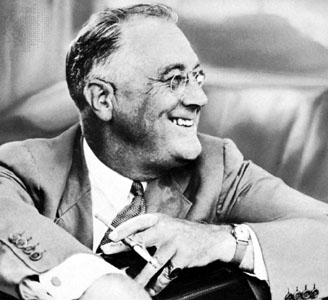
In such a spirit on my part and on yours we face our common difficulties. They concern, thank God, only material things. Values have shrunken to fantastic levels; taxes have risen; our ability to pay has fallen; government of all kinds is faced by serious curtailment of income; the means of exchange are frozen in the currents of trade; the withered leaves of industrial enterprise lie on every side; farmers find no markets for their produce; the savings of many years in thousands of families are gone.
More important, a host of unemployed citizens face the grim problem of existence, and an equally great number toil with little return. Only a foolish optimist can deny the dark realities of the moment.
Yet our distress comes from no failure of substance. We are stricken by no plague of locusts. Compared with the perils which our forefathers conquered because they believed and were not afraid, we have still much to be thankful for. Nature still offers her bounty and human efforts have multiplied it. Plenty is at our doorstep, but a generous use of it languishes in the very sight of the supply. Primarily this is because the rulers of the exchange of mankind’s goods have failed, through their own stubbornness and their own incompetence, have admitted their failure, and abdicated. Practices of the unscrupulous money changers stand indicted in the court of public opinion, rejected by the hearts and minds of men.True they have tried, but their efforts have been cast in the pattern of an outworn tradition. Faced by failure of credit they have proposed only the lending of more money. Stripped of the lure of profit by which to induce our people to follow their false leadership, they have resorted to exhortations, pleading tearfully for restored confidence. They know only the rules of a generation of self-seekers. They have no vision, and when there is no vision the people perish.
The money changers have fled from their high seats in the temple of our civilization. We may now restore that temple to the ancient truths. The measure of the restoration lies in the extent to which we apply social values more noble than mere monetary profit.
Happiness lies not in the mere possession of money; it lies in the joy of achievement, in the thrill of creative effort. The joy and moral stimulation of work no longer must be forgotten in the mad chase of evanescent profits. These dark days will be worth all they cost us if they teach us that our true destiny is not to be ministered unto but to minister to ourselves and to our fellow men.
Recognition of the falsity of material wealth as the standard of success goes hand in hand with the abandonment of the false belief that public office and high political position are to be valued only by the standards of pride of place and personal profit; and there must be an end to a conduct in banking and in business which too often has given to a sacred trust the likeness of callous and selfish wrongdoing. Small wonder that confidence languishes, for it thrives only on honesty, on honor, on the sacredness of obligations, on faithful protection, on unselfish performance; without them it cannot live.
Restoration calls, however, not for changes in ethics alone. This Nation asks for action, and action now.
Our greatest primary task is to put people to work. This is no unsolvable problem if we face it wisely and courageously. It can be accomplished in part by direct recruiting by the Government itself, treating the task as we would treat the emergency of a war, but at the same time, through this employment, accomplishing greatly needed projects to stimulate and reorganize the use of our natural resources.
Hand in hand with this we must frankly recognize the overbalance of population in our industrial centers and, by engaging on a national scale in a redistribution, endeavor to provide a better use of the land for those best fitted for the land. The task can be helped by definite efforts to raise the values of agricultural products and with this the power to purchase the output of our cities. It can be helped by preventing realistically the tragedy of the growing loss through foreclosure of our small homes and our farms. It can be helped by insistence that the Federal, State, and local governments act forthwith on the demand that their cost be drastically reduced. It can be helped by the unifying of relief activities which today are often scattered, uneconomical, and unequal. It can be helped by national planning for and supervision of all forms of transportation and of communications and other utilities which have a definitely public character. There are many ways in which it can be helped, but it can never be helped merely by talking about it. We must act and act quickly.Finally, in our progress toward a resumption of work we require two safeguards against a return of the evils of the old order; there must be a strict supervision of all banking and credits and investments; there must be an end to speculation with other people’s money, and there must be provision for an adequate but sound currency.
There are the lines of attack. I shall presently urge upon a new Congress in special session detailed measures for their fulfillment, and I shall seek the immediate assistance of the several States.
Through this program of action we address ourselves to putting our own national house in order and making income balance outgo. Our international trade relations, though vastly important, are in point of time and necessity secondary to the establishment of a sound national economy. I favor as a practical policy the putting of first things first. I shall spare no effort to restore world trade by international economic readjustment, but the emergency at home cannot wait on that accomplishment.
The basic thought that guides these specific means of national recovery is not narrowly nationalistic. It is the insistence, as a first consideration, upon the interdependence of the various elements in all parts of the United States—a recognition of the old and permanently important manifestation of the American spirit of the pioneer. It is the way to recovery. It is the immediate way. It is the strongest assurance that the recovery will endure.
In the field of world policy I would dedicate this Nation to the policy of the good neighbor—the neighbor who resolutely respects himself and, because he does so, respects the rights of others—the neighbor who respects his obligations and respects the sanctity of his agreements in and with a world of neighbors.
If I read the temper of our people correctly, we now realize as we have never realized before our interdependence on each other; that we can not merely take but we must give as well; that if we are to go forward, we must move as a trained and loyal army willing to sacrifice for the good of a common discipline, because without such discipline no progress is made, no leadership becomes effective. We are, I know, ready and willing to submit our lives and property to such discipline, because it makes possible a leadership which aims at a larger good. This I propose to offer, pledging that the larger purposes will bind upon us all as a sacred obligation with a unity of duty hitherto evoked only in time of armed strife.
With this pledge taken, I assume unhesitatingly the leadership of this great army of our people dedicated to a disciplined attack upon our common problems.
Action in this image and to this end is feasible under the form of government which we have inherited from our ancestors. Our Constitution is so simple and practical that it is possible always to meet extraordinary needs by changes in emphasis and arrangement without loss of essential form. That is why our constitutional system has proved itself the most superbly enduring political mechanism the modern world has produced. It has met every stress of vast expansion of territory, of foreign wars, of bitter internal strife, of world relations.
It is to be hoped that the normal balance of executive and legislative authority may be wholly adequate to meet the unprecedented task before us. But it may be that an unprecedented demand and need for undelayed action may call for temporary departure from that normal balance of public procedure.
I am prepared under my constitutional duty to recommend the measures that a stricken nation in the midst of a stricken world may require. These measures, or such other measures as the Congress may build out of its experience and wisdom, I shall seek, within my constitutional authority, to bring to speedy adoption.
But in the event that the Congress shall fail to take one of these two courses, and in the event that the national emergency is still critical, I shall not evade the clear course of duty that will then confront me. I shall ask the Congress for the one remaining instrument to meet the crisis—broad Executive power to wage a war against the emergency, as great as the power that would be given to me if we were in fact invaded by a foreign foe.
For the trust reposed in me I will return the courage and the devotion that befit the time. I can do no less.
We face the arduous days that lie before us in the warm courage of the national unity; with the clear consciousness of seeking old and precious moral values; with the clean satisfaction that comes from the stern performance of duty by old and young alike. We aim at the assurance of a rounded and permanent national life.
We do not distrust the future of essential democracy. The people of the United States have not failed. In their need they have registered a mandate that they want direct, vigorous action. They have asked for discipline and direction under leadership. They have made me the present instrument of their wishes. In the spirit of the gift I take it.
In this dedication of a Nation we humbly ask the blessing of God. May He protect each and every one of us. May He guide me in the days to come.
Acceptance Speech for the 1932 Democratic Convention
I appreciate your willingness after these six arduous days to remain here, for I know well the sleepless hours which you and I have had. I regret that I am late, but I have no control over the winds of Heaven and could only be thankful for my Navy training.
The appearance before a National Convention of its nominee for President, to be formally notified of his selection, is unprecedented and unusual, but these are unprecedented and unusual times. I have started out on the tasks that lie ahead by breaking the absurd traditions that the candidate should remain in professed ignorance of what has happened for weeks until he is formally notified of that event many weeks later.
My friends, may this be the symbol of my intention to be honest and to avoid all hypocrisy or sham, to avoid all silly shutting of the eyes to the truth in this campaign. You have nominated me and I know it, and I am here to thank you for the honor.
Let it also be symbolic that in so doing I broke traditions. Let it be from now on the task of our Party to break foolish traditions. We will break foolish traditions and leave it to the Republican leadership, far more skilled in that art, to break promises.
Let us now and here highly resolve to resume the country’s interrupted march along the path of real progress, of real justice, of real equality for all of our citizens, great and small. Our indomitable leader in that interrupted march is no longer with us, but there still survives today his spirit. Many of his captains, thank God, are still with us, to give us wise counsel. Let us feel that in everything we do there still lives with us, if not the body, the great indomitable, unquenchable, progressive soul of our Commander-in-Chief, Woodrow Wilson.
I have many things on which I want to make my position clear at the earliest possible moment in this campaign. That admirable document, the platform which you have adopted, is clear. I accept it 100 percent.
And you can accept my pledge that I will leave no doubt or ambiguity on where I stand on any question of moment in this campaign.
As we enter this new battle, let us keep always present with us some of the ideals of the Party: The fact that the Democratic Party by tradition and by the continuing logic of history, past and present, is the bearer of liberalism and of progress and at the same time of safety to our institutions. And if this appeal fails, remember well, my friends, that a resentment against the failure of Republican leadership—and note well that in this campaign I shall not use the word "Republican Party," but I shall use, day in and day out, the words, "Republican leadership"—the failure of Republican leaders to solve our troubles may degenerate into unreasoning radicalism.
The great social phenomenon of this depression, unlike others before it, is that it has produced but a few of the disorderly manifestations that too often attend upon such times.
Wild radicalism has made few converts, and the greatest tribute that I can pay to my countrymen is that in these days of crushing want there persists an orderly and hopeful spirit on the part of the millions of our people who have suffered so much. To fail to offer them a new chance is not only to betray their hopes but to misunderstand their patience.
To meet by reaction that danger of radicalism is to invite disaster. Reaction is no barrier to the radical. It is a challenge, a provocation. The way to meet that danger is to offer a workable program of reconstruction, and the party to offer it is the party with clean hands.
This, and this only, is a proper protection against blind reaction on the one hand and an improvised, hit-or-miss, irresponsible opportunism on the other.
There are two ways of viewing the Government’s duty in matters affecting economic and social life. The first sees to it that a favored few are helped and hopes that some of their prosperity will leak through, sift through, to labor, to the farmer, to the small business man. That theory belongs to the party of Toryism, and I had hoped that most of the Tories left this country in 1776
But it is not and never will be the theory of the Democratic Party. This is no time for fear, for reaction or for timidity. Here and now I invite those nominal Republicans who find that their conscience cannot be squared with the groping and the failure of their party leaders to join hands with us; here and now, in equal measure, I warn those nominal Democrats who squint at the future with their faces turned toward the past, and who feel no responsibility to the demands of the new time, that they are out of step with their Party.
Yes, the people of this country want a genuine choice this year, not a choice between two names for the same reactionary doctrine. Ours must be a party of liberal thought, of planned action, of enlightened international outlook, and of the greatest good to the greatest number of our citizens.
Now it is inevitable—and the choice is that of the times—it is inevitable that the main issue of this campaign should revolve about the clear fact of our economic condition, a depression so deep that it is without precedent in modern history. It will not do merely to state, as do Republican leaders to explain their broken promises of continued inaction, that the depression is worldwide. That was not their explanation of the apparent prosperity of 1928. The people will not forget the claim made by them then that prosperity was only a domestic product manufactured by a Republican President and a Republican Congress. If they claim paternity for the one they cannot deny paternity for the other.
I cannot take up all the problems today. I want to touch on a few that are vital. Let us look a little at the recent history and the simple economics, the kind of economics that you and I and the average man and woman talk.
In the years before 1929 we know that this country had completed a vast cycle of building and inflation; for ten years we expanded on the theory of repairing the wastes of the War, but actually expanding far beyond that, and also beyond our natural and normal growth. Now it is worth remembering, and the cold figures of finance prove it, that during that time there was little or no drop in the prices that the consumer had to pay, although those same figures proved that the cost of production fell very greatly; corporate profit resulting from this period was enormous; at the same time little of that profit was devoted to the reduction of prices. The consumer was forgotten. Very little of it went into increased wages; the worker was forgotten, and by no means an adequate proportion was even paid out in dividends--the stockholder was forgotten.
And, incidentally, very little of it was taken by taxation to the beneficent Government of those years.
What was the result? Enormous corporate surpluses piled up—the most stupendous in history. Where, under the spell of delirious speculation, did those surpluses go? Let us talk economics that the figures prove and that we can understand. Why, they went chiefly in two directions: first, into new and unnecessary plants which now stand stark and idle; and second, into the call-money market of Wall Street, either directly by the corporations, or indirectly through the banks. Those are the facts. Why blink at them?
Then came the crash. You know the story. Surpluses invested in unnecessary plants became idle. Men lost their jobs; purchasing power dried up; banks became frightened and started calling loans. Those who had money were afraid to part with it. Credit contracted. Industry stopped. Commerce declined, and unemployment mounted.
And there we are today.
Translate that into human terms. See how the events of the past three years have come home to specific groups of people: first, the group dependent on industry; second, the group dependent on agriculture; third, and made up in large part of members of the first two groups, the people who are called "small investors and depositors." In fact, the strongest possible tie between the first two groups, agriculture and industry, is the fact that the savings and to a degree the security of both are tied together in that third group--the credit structure of the Nation.
Never in history have the interests of all the people been so united in a single economic problem. Picture to yourself, for instance, the great groups of property owned by millions of our citizens, represented by credits issued in the form of bonds and mortgages—Government bonds of all kinds, Federal, State, county, municipal; bonds of industrial companies, of utility companies; mortgages on real estate in farms and cities, and finally the vast investments of the Nation in the railroads. What is the measure of the security of each of those groups? We know well that in our complicated, interrelated credit structure if any one of these credit groups collapses they may all collapse. Danger to one is danger to all.
How, I ask, has the present Administration in Washington treated the interrelationship of these credit groups? The answer is clear: It has not recognized that interrelationship existed at all. Why, the Nation asks, has Washington failed to understand that all of these groups, each and every one, the top of the pyramid and the bottom of the pyramid, must be considered together, that each and every one of them is dependent on every other; each and every one of them affecting the whole financial fabric?
Statesmanship and vision, my friends, require relief to all at the same time.…
At last our eyes are open. At last the American people are ready to acknowledge that Republican leadership was wrong and that the Democracy is right.
My program, of which I can only touch on these points, is based upon this simple moral principle: the welfare and the soundness of a Nation depend first upon what the great mass of the people wish and need; and second, whether or not they are getting it.
What do the people of America want more than anything else? To my mind, they want two things: work, with all the moral and spiritual values that go with it; and with work, a reasonable measure of security—security for themselves and for their wives and children. Work and security--these are more than words. They are more than facts. They are the spiritual values, the true goal toward which our efforts of reconstruction should lead. These are the values that this program is intended to gain; these are the values we have failed to achieve by the leadership we now have.
Our Republican leaders tell us economic laws—sacred, inviolable, unchangeable—cause panics which no one could prevent. But while they prate of economic laws, men and women are starving. We must lay hold of the fact that economic laws are not made by nature. They are made by human beings. Yes, when—not if—when we get the chance, the Federal Government will assume bold leadership in distress relief. For years Washington has alternated between putting its head in the sand and saying there is no large number of destitute people in our midst who need food and clothing, and then saying the States should take care of them, if there are. Instead of planning two and a half years ago to do what they are now trying to do, they kept putting it off from day to day, week to week, and month to month, until the conscience of America demanded action.
I say that while primary responsibility for relief rests with localities now, as ever, yet the Federal Government has always had and still has a continuing responsibility for the broader public welfare. It will soon fulfill that responsibility.…
One word more: Out of every crisis, every tribulation, every disaster, mankind rises with some share of greater knowledge, of higher decency, of purer purpose. Today we shall have come through a period of loose thinking, descending morals, an era of selfishness, among individual men and women and among Nations. Blame not Governments alone for this. Blame ourselves in equal share. Let us be frank in acknowledgment of the truth that many amongst us have made obeisance to Mammon, that the profits of speculation, the easy road without toil, have lured us from the old barricades. To return to higher standards we must abandon the false prophets and seek new leaders of our own choosing.
Never before in modern history have the essential differences between the two major American parties stood out in such striking contrast as they do today. Republican leaders not only have failed in material things, they have failed in national vision, because in disaster they have held out no hope, they have pointed out no path for the people below to climb back to places of security and of safety in our American life.
Throughout the Nation, men and women, forgotten in the political philosophy of the Government of the last years look to us here for guidance and for more equitable opportunity to share in the distribution of national wealth.
On the farms, in the large metropolitan areas, in the smaller cities and in the villages, millions of our citizens cherish the hope that their old standards of living and of thought have not gone forever. Those millions cannot and shall not hope in vain.

Glynn Braman
